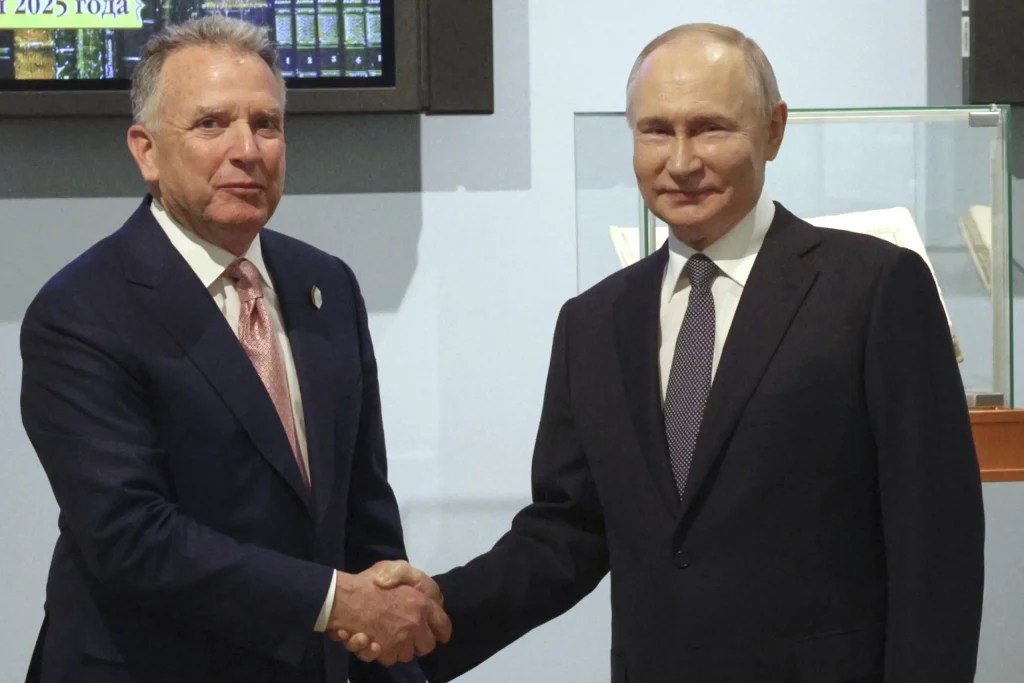
Witkoff praises Putin as a humanitarian — to his shame and ours
Read full story at Washington Examiner →Steve Witkoff arrived in St. Petersburg on Tuesday as Trump's special presidential envoy to pitch a Ukraine ceasefire deal directly to Putin. During those talks, Witkoff told Russian state media that Putin is "a humanitarian" working toward peace—a characterization so divorced from documented reality that it raises immediate questions about either Witkoff's briefing materials or his willingness to validate propaganda for diplomatic advantage. Witkoff is a longtime Trump ally, a former professional golfer and sports agent who was tapped for this Ukraine portfolio specifically because of his personal relationship with the president, not because of expertise in Russian affairs or Cold War history. His comment wasn't an offhand remark; it was made to reporters and echoed by Russian state outlets within hours, amplifying the Kremlin's preferred self-image to global audiences.
The factual record contradicts Witkoff's framing entirely. Putin has been credibly documented by human rights organizations, NATO intelligence, and independent journalists to have ordered the poisoning of political opponents (Alexei Navalny, Alexander Litvinenko), orchestrated the annexation of Crimea and invasion of eastern Ukraine that has killed over 600,000 people according to Ukrainian estimates, directed the systematic torture of detainees in occupied territories, and deployed chemical and biological weapons in Syria. Russia's own human rights ombudsman quit in 2022 over the government's atrocities. The praise "humanitarian" doesn't map onto any measurable definition of the word when applied to someone credibly accused of war crimes.
The strategic problem here runs deeper than one envoy's poor word choice. When American officials publicly validate enemy narratives during active negotiations, they remove leverage. Putin's entire negotiating position depends on convincing the world he's a reasonable actor working toward peace—exactly the image Witkoff just handed him for free. Ukraine's negotiating position, by contrast, depends on maintaining international consensus that Russia initiated an illegal invasion and bears responsibility for ending it. By praising Putin, Witkoff undermined Kyiv's diplomatic posture without apparent reciprocal concessions. Trump administration officials later walked back the "humanitarian" language, but the damage—amplified through Russian state media—was already locked in.
The conservative argument here has genuine force: Trump ran on ending the Ukraine war, and backchannel negotiations with adversaries are normal statecraft. Using diplomatic language, even flattering language, to open doors with hostile powers has precedent. But there's a difference between tactical flattery and wholesale validation of an opponent's self-presentation. Eisenhower met Khrushchev; he didn't call him a friend of democracy. Reagan negotiated with the Soviet Union; he didn't erase the Cold War record. Witkoff's comment wasn't diplomatic minimalism—it was affirmative praise for a specific personal attribute, delivered to state media in a way designed to be broadcast. If the Trump team wanted to negotiate, they could have done so without handing Putin a soundbite.
The immediate question is whether this reflects Trump's actual negotiating strategy or Witkoff's freelancing. Trump has made contradictory statements on Ukraine—praising Zelenskyy, then demanding quick capitulation, then suggesting long-term NATO presence could justify continued aid. If Trump genuinely wants a deal, he needs to clarify whether his envoys are authorized to publicly lionize adversaries, or whether Witkoff overstepped. The next visible marker is the actual ceasefire proposal—what terms Witkoff brought to Putin, whether Russia responds seriously, and whether the U.S. pressures Ukraine to accept unfavorable conditions under the guise of peace. Watch whether State Department principals (Secretary Rubio, in particular) distance themselves from Witkoff's language, and whether Congress demands a classified briefing on what was actually discussed in St. Petersburg versus what Witkoff told the press.