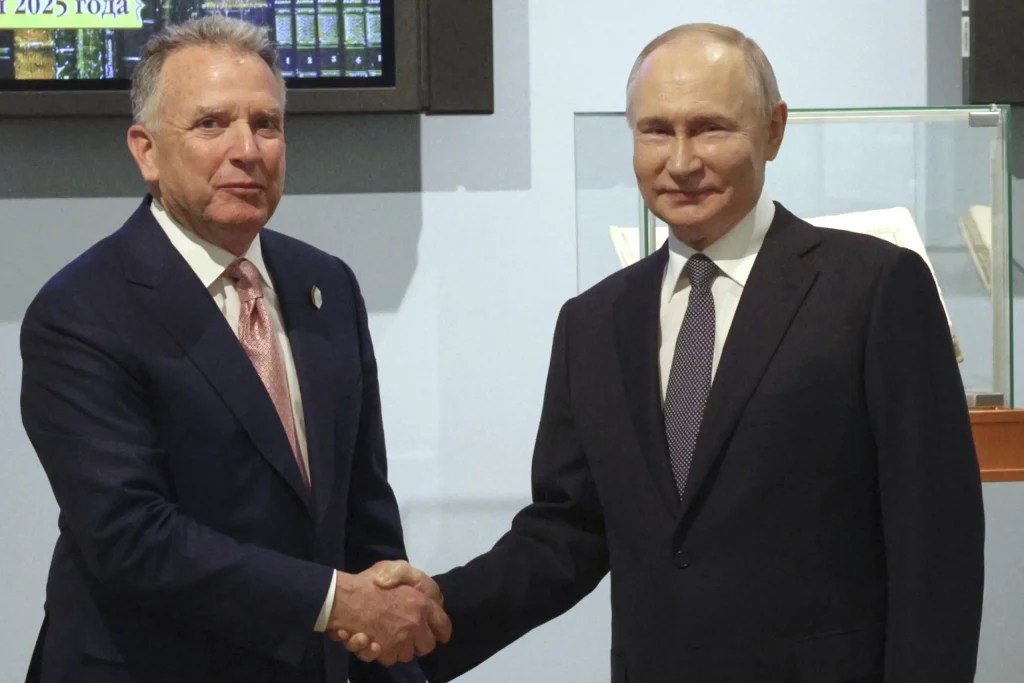
Witkoff praises Putin as a humanitarian — to his shame and ours
Read full story at Washington Examiner →Steve Witkoff walked into St. Petersburg on Tuesday as Trump's special envoy for Middle East peace and walked out having described Vladimir Putin—a man credibly accused of poisoning political opponents, orchestrating the invasion of a sovereign nation that has killed over 600,000 people, and running one of the world's most systematized torture systems—as a "humanitarian." Witkoff made these comments during negotiations over a Ukraine ceasefire, ostensibly representing American interests. The phrase wasn't a slip or mistranslation. Witkoff told reporters Putin was acting as a "humanitarian" by engaging in ceasefire talks. This matters because it's not just embarrassing rhetoric; it's the official posture of the American government toward a regime whose documented abuses include the systematic rape of Ukrainian prisoners, the forced deportation of Ukrainian children, and the execution of surrendered soldiers.
The context here is crucial. Witkoff, a Manhattan real estate executive and Trump loyalist with no foreign policy background, has been given enormous latitude in shaping Trump's approach to Ukraine and Russia. His trip to St. Petersburg was framed as groundwork for ending the war—reasonable diplomatic work, theoretically. But the framing of Putin as humanitarian while that war continues is functionally a concession before negotiations even begin. It signals to Putin that the American negotiating team has already accepted a particular moral framework: that Russian participation in ceasefire talks is itself an act of benevolence requiring praise. Ukraine, which has lost territory the size of Massachusetts and sustained casualties exceeding 400,000, isn't being praised for its "humanitarian" willingness to negotiate. Neither is Volodymyr Zelensky, whose government has been scrambling to avoid losing more territory to Russian advances.
This inverts the historical posture America has held since the Cold War. During the Soviet era, American envoys negotiated with Soviet leaders over arms control and regional conflicts, but they did so without performing propaganda favors for the regime. Reagan negotiated with Gorbachev, but he didn't call him humanitarian. Bush Sr. dealt with the Soviet collapse, but praise was calibrated and conditional. The closest parallel is probably the Nixon administration's opening to China—but even there, the concessions were strategic, not rhetorical. What's happening now is different: the Trump administration is offering unearned diplomatic praise to a genocidal regime as a gesture of goodwill, setting the baseline for negotiations lower than any American administration in living memory.
From the right's perspective—the actual conservative case, not the Trumpist version—this is a strategic disaster. If you believe America should negotiate with Russia to end the bloodshed in Ukraine, fine. But you don't gift Putin propaganda victories in the process. You don't let your envoy become a tool for Putin's messaging apparatus. You don't describe a man overseeing mass atrocities as humanitarian. Even if you think Ukraine can't win militarily and America shouldn't fund an endless proxy war, you protect American credibility by distinguishing between pragmatic negotiation and moral abdication. When Witkoff praises Putin, he's not being pragmatic—he's ceding the language itself. He's telling every American ally watching that our word about human rights is transactional, available for trade.
What matters next is whether this represents Trump's actual position or an embarrassment Witkoff will walk back. If it's the former, every NATO ally watching has to recalibrate what American security guarantees mean. If it's the latter, the damage to Witkoff's credibility as a negotiator is already done—Putin now knows he can get praise simply by showing up to talks. The concrete thing to watch is the ceasefire framework that emerges from these negotiations. Will it include any accountability mechanisms for war crimes? Will it require Russian withdrawal from occupied territory, or freeze current lines? Will it demand return of deported Ukrainians? The quality of those answers will tell you whether Witkoff's praise was the opening move in a serious negotiation or just the first of many moral surrenders.