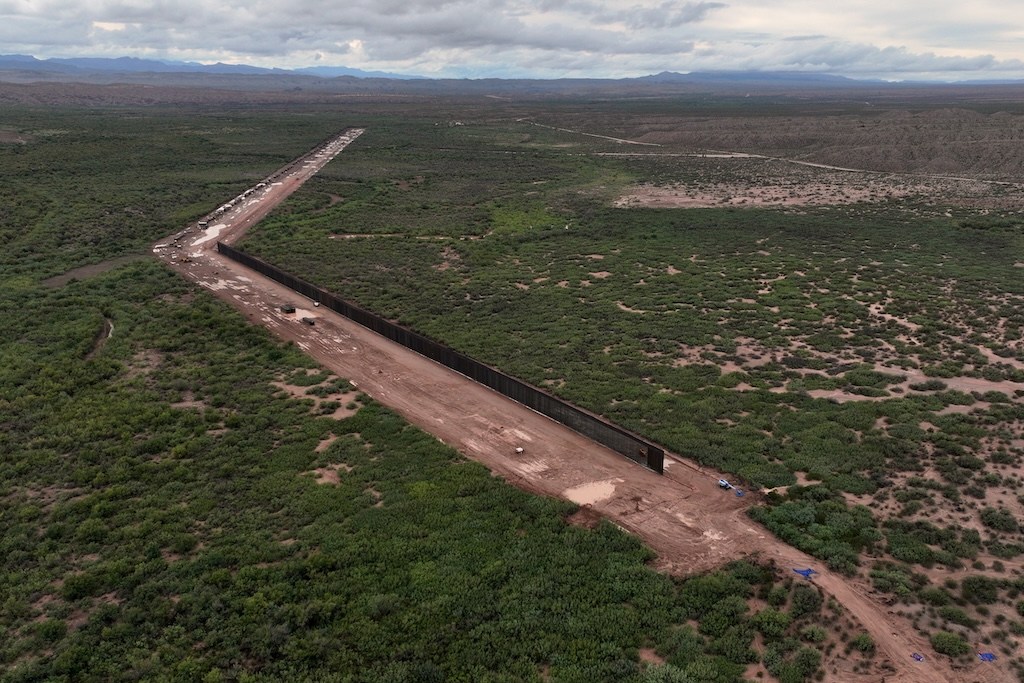
Trump administration asks Supreme Court to lift block on Big Bend border wall construction
Read full story at Washington Examiner →The Trump administration's emergency petition to the Supreme Court Wednesday centers on a straightforward legal collision: a federal judge in Texas has blocked construction on roughly 20 miles of border wall in Big Bend National Park, and the administration wants that blockade lifted immediately. Solicitor General D. John Sauer filed the request arguing the injunction is "baseless," but the underlying dispute involves competing claims about environmental law, presidential authority, and land management that have tied up this particular stretch of border since before the 2020 election. The Big Bend section matters because it's one of the few remaining stretches where the Trump administration can claim visible progress on wall construction—most other sites were completed during Trump's first term or face their own legal entanglements.
The blocked construction sits at the intersection of three separate legal frameworks. Big Bend National Park is protected land that sits in a congressionally designated wilderness area, which carries different permitting requirements than ordinary federal land. Environmental groups and park advocates have challenged the wall project on grounds that it violates the National Environmental Policy Act and the Wilderness Act, requiring formal impact assessments before construction can proceed. A federal judge agreed and issued the injunction. The Trump administration counters that it has sufficient legal authority to build and that the environmental review process has been satisfied. The question before the Supreme Court is whether the injunction should remain in place while the underlying case moves through the courts, or whether work can resume immediately.
What's genuinely at stake here involves real dollars and construction timelines. The administration is racing against the calendar—it has signaled an ambitious goal to expand wall construction significantly in its second term, and every month of delay makes that harder. Construction firms have contracts in place and crews ready to move into Big Bend. But for the government, this case also tests whether it can sidestep the judicial review process by moving fast enough and asking for emergency relief directly from the Supreme Court. That precedent matters beyond border policy.
The conservative reading here is straightforward: the executive branch is charged with securing the border, Congress has appropriated funds for wall construction, and courts are using environmental review as a delaying mechanism to block legitimate policy implementation. From this angle, the Wilderness Act was written for conservation purposes, not to create an indefinite veto over national security infrastructure. Environmental groups and their allies have had years to litigate this, and the permanent injunction amounts to judicial obstruction of executive authority. The Trump administration is correct that the courts shouldn't be able to freeze major policy initiatives indefinitely while process questions get endlessly relitigated.
The Supreme Court's response will come quickly—emergency petitions don't linger on the docket. The justices could grant the request, which would immediately lift the injunction and allow work to resume; deny it, which keeps the block in place; or issue a more limited order addressing just specific aspects. If they grant it, construction could restart within days. If they deny it, the case will continue grinding through the lower courts, potentially for years. Watch for the decision within weeks at most. Separately, watch whether other judges in other districts move to issue their own injunctions on similar Big Bend or related border construction projects—legal strategy often involves a race to the courthouse.