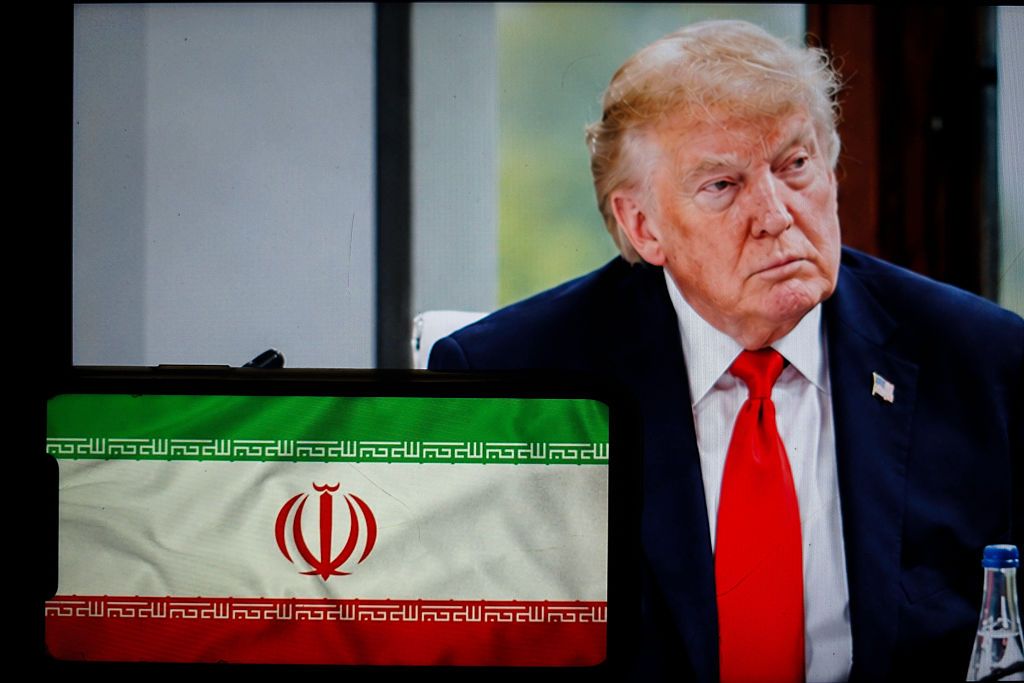
Like Bush’s surge, Trump’s Iran war took courage. And victory is near
Read full story at Washington Examiner →# Why This Matters
David Albright is not a partisan operative. The nuclear physicist founded the Institute for Science and International Security in 1990 and has spent three decades as the go-to expert for journalists, lawmakers, and administrations of both parties seeking credible analysis of Iran's nuclear program. Last week, when CNN reported that Trump administration officials were considering massive ordnance air burst (MOAB) strikes against Iran's Pickaxe Mountain nuclear facility, Albright didn't dismiss the report as saber-rattling. Instead, he publicly stated that such strikes could set back Iran's nuclear weapons program by years—a technical assessment from someone without ideological skin in the game. That matters because it signals potential viability to what sounds like apocalyptic rhetoric.
The backdrop is Trump's 2018 withdrawal from the Joint Comprehensive Plan of Action (JCPOA), the nuclear deal negotiated under Obama that placed Iran's enrichment under international inspection. After Trump's exit and the reimposition of maximum pressure sanctions, Iran resumed enrichment at higher concentrations and faster rates. By 2023, international inspectors confirmed Iran possessed uranium enriched to 60 percent purity—near weapons-grade 90 percent. The Pickaxe Mountain facility, also called Fordow, is where much of this advanced enrichment occurs, buried in a mountain facility that survived Israel's 2015 intelligence coup but remains a persistent headache for Western intelligence. The Iranian government explicitly stated last month that further Israeli strikes could push them toward weaponization, a threshold the Trump team says it will not permit.
The military mechanism under consideration isn't fantasy. The MOAB—Massive Ordnance Air Burst, weighing 21,600 pounds—was used sparingly in Afghanistan against ISIS tunnel networks and was developed precisely for hardened targets. The Air Force has refined bunker-buster tactics since the Iraq War, when penetrating bombs failed repeatedly against deeply fortified structures. What's changed is precision and yield; modern versions can penetrate significantly deeper before detonation. Albright's assessment that such strikes could delay Iran's program by years rests on a specific calculation: Fordow's enrichment cascades, the centrifuge arrays that produce weapons-usable material, are replaceable, but the facility's infrastructure—electrical systems, ventilation, command centers—would take 12-24 months to rebuild. That's the math that makes this operationally viable, not just theoretically possible.
The conservative argument here is straightforward: Obama's deal rewarded Iran's cheating with legitimacy and buyout. Sixteen years of secret nuclear work before 2015 went unpunished and largely unverified. Even under the JCPOA's inspection regime, Iran ran parallel procurement networks, violated enrichment caps, and moved toward weaponization the moment Trump left office. Waiting for negotiations or UN resolutions while Iran's nuclear clock runs backward is surrender by another name. If Iran crosses the weaponization threshold and develops missiles capable of reaching the U.S. heartland—technology they're actively advancing—the cost of deterrence balloons infinitely. A strike now, on weapons infrastructure, prevents a far costlier confrontation later. Trump's willingness to consider it, and to leak it as a credible threat, may be the only thing keeping Iran's nuclear planners up at night. That's leverage that actually works.
The immediate test comes in the next 60 days. Iran's nuclear scientists know Trump returns to office without the institutional constraints Obama faced. Negotiations stalled through Biden's term will either restart under explicit threat, or Iran will accelerate enrichment to cross the weaponization line before military action becomes politically viable. Watch for IAEA inspections at Fordow—if Iran obstructs or expels monitors, it signals they're preparing for the endgame. Watch also for public statements from Trump's defense secretary, Pete Hegseth, and Secretary of State Marco Rubio on Iran's uranium levels. Any announcement that enrichment has exceeded 70 percent would be the trigger point for irreversible decisions. Unlike the Bush surge in Iraq, which was politically divisive, a strike against