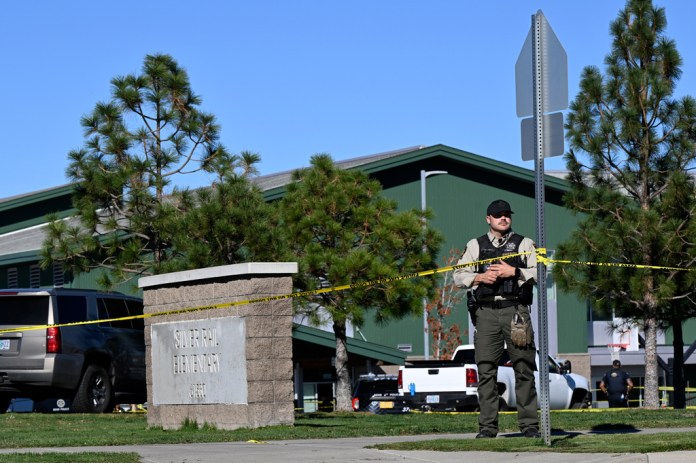
Four dead, including three children, in Oregon elementary school shooting
Read full story at Washington Examiner →# Why This Matters
A 16-year-old gunman entered Cascade Elementary School in Bend, Oregon on Thursday afternoon and fired on students and staff, killing three children aged 5, 8, and 11, plus teacher Krista Westerfield, 36. Bend Police Chief Mike Krantz confirmed the toll. The shooter was killed after an unidentified community member pursued him into the school and confronted him—the specific circumstances of that final exchange remain unclear pending investigation. This marks Oregon's deadliest school shooting since the 1998 Thurston High shooting that killed four students and a teacher in Springfield.
Bend is a town of roughly 100,000 in central Oregon, approximately 160 miles southeast of Portland. Cascade Elementary serves grades K-5 and enrolls around 400 students. The shooting occurred at approximately 1:30 p.m. during school hours, meaning hundreds of children were present. The remaining students and staff were evacuated or sheltered in place. Beyond the five dead, the full extent of injuries is not yet public—critical given that shooters at school sites often wound multiple people before being stopped.
The role of the armed community member who intervened introduces a live debate point. Schools nationwide vary sharply on whether armed staff or community members on site increase safety or create additional risks. Bend had no formal armed school resource officer present—the shooter was stopped by a civilian who made a split-second decision to engage. That civilian's identity, training level, and what exactly transpired when confronting the shooter have not been disclosed, creating an immediate information vacuum on the mechanics that actually ended the attack.
Conservative interpretation is direct: a citizen with a gun stopped an active shooter at an elementary school. Period. The mechanism that saved lives Thursday—before police arrived—was not a law enforcement officer, not a lockdown protocol, not an active shooter drill, but a person willing to act and capable of action. This is precisely what Second Amendment advocates have long argued: armed citizens deter or stop mass violence. The counter-narrative about gun control cannot logically explain why a teenager obtained a firearm in a state with universal background checks, red flag laws, and a 10-day waiting period. Focus on the specific failures—did the shooter's parents secure the weapon, was there prior threat assessment, did school officials know something—rather than abstract gun policy.
Federal law enforcement will now investigate the shooter's background, family situation, online activity, and school records for motive and warning signs. Oregon State Police and the FBI typically coordinate in school shooting investigations. The specific question: whether the shooter exhibited threatening behavior that school or law enforcement was aware of before Thursday. Local media reports from prior incidents in other states frequently reveal documented warning signs that were not escalated. That investigation will determine whether this was a random act or preventable.
Watch for: Bend Police and state investigators to release the shooter's name, age confirmation, and any prior police contact within 24-48 hours; the school district's statement on whether staff or families had reported concerns about this student; ballistics and weapon origin (legally obtained, stolen, home access); and whether the community member who engaged the shooter is named and his or her account of the confrontation emerges. The pressure for narrative control will be immediate—expect competing claims about what "really" ended the shooting.