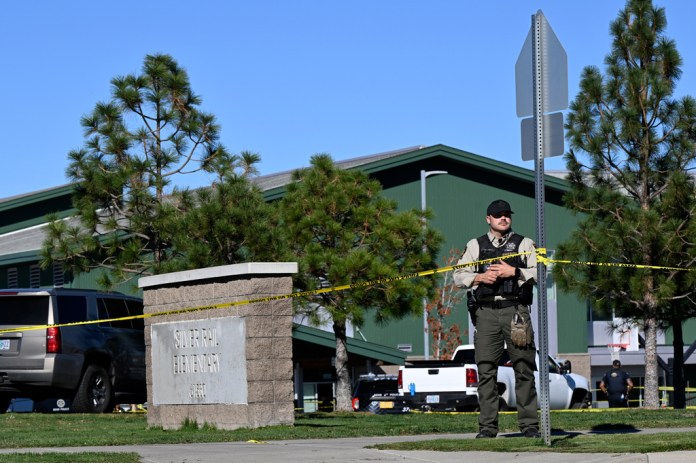
Four dead, including three children, in Oregon elementary school shooting
Read full story at Washington Examiner →# Why This Matters
A 16-year-old opened fire at Caldera High School in Bend, Oregon on Thursday afternoon, killing four people—a teacher and three elementary-age children aged 5, 8, and 11. The shooter was killed after a community member pursued him into the building. Bend Police Chief Mike Krantz confirmed the identities but declined to release the shooter's name or motive pending investigation. This is Oregon's deadliest school shooting since the 1998 Thurston High School incident in Springfield, which killed four students and a teacher.
What distinguishes this case in the immediate policy environment is the role of armed response. Unlike Uvalde or Parkland—where law enforcement delayed entry or failed to engage—the community intervener's direct action appears to have halted the shooting before more victims accumulated. This detail cuts against the dominant post-shooting narrative of police failure and creates an awkward variable for advocates on both sides: it suggests that an armed civilian, not a trained officer, may have prevented a higher body count. That complicates the purely structural arguments about police reform or gun restriction that dominate the national conversation after these events.
Oregon has some of the strictest gun laws in the country. A 2022 permit-to-purchase requirement means anyone buying a gun must first obtain a permit from local law enforcement after a background check and waiting period. The state also has a red-flag law allowing police to temporarily remove guns from people deemed dangerous. Neither prevented this incident. The shooter's acquisition method and whether he obtained the weapon legally, or his background relative to these screening mechanisms, remain unknown but will become central to the policy response.
The conservative read is straightforward: a deranged minor committed murder; a courageous civilian stopped him. The cascading question isn't "how do we pass more laws?" but "why did the existing comprehensive framework fail?" Oregon already required permits. The state already has extreme risk protections. The shooter was apparently known to authorities or the community well enough that someone was present to pursue him immediately. This is the failure point: not the availability of guns to the general law-abiding population, but the gap between threat assessment and intervention at the individual level, and the legal and institutional barriers that prevented action before Thursday.
The next critical disclosure will be the shooter's background: whether he had documented mental health concerns, prior threats, police contacts, or parental warnings that should have triggered Oregon's red-flag statute. If officials had visibility into his dangerousness and did nothing, that's a separate accountability story than mass gun availability. The investigation phase will determine whether the permit-to-purchase system was even applied, and whether the gun was acquired before the law took effect in 2024 or obtained illegally. Watch for the state's response to demand the shooter's records—both will frame how this enters the 2024 election cycle and the broader debate on school safety versus gun regulation.