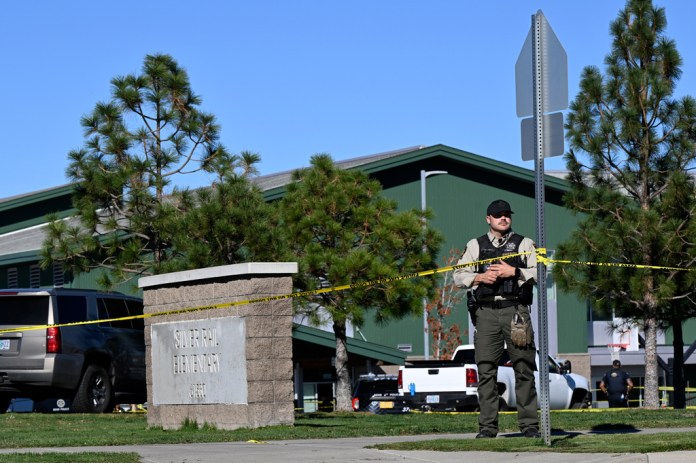
Four dead, including three children, in Oregon elementary school shooting
Read full story at Washington Examiner →# Why This Matters
A 16-year-old opened fire at Riverside Elementary School in Bend, Oregon on Thursday afternoon, killing a 5-year-old, an 8-year-old, an 11-year-old, and a 56-year-old teacher before being shot dead by a community member who pursued him into the building. Bend Police Chief Mike Krantz confirmed the identities and ages but provided limited detail on how the teenager obtained the firearm or what precipitated the shooting. The school serves roughly 350 students in a city of 100,000 in central Oregon's Deschutes County. The incident marks the 67th school shooting in the United States this year by Gun Violence Archive counts, though the exact number varies depending on how incidents are defined.
The concrete stakes here are immediate and permanent: three elementary-aged children will not return to school, a teacher's family lost a breadwinner, and a school community has been fractured in a way that transcends policy debate. Riverside Elementary will likely require extensive renovation or may not reopen in its current form. The shooter's family faces questions about firearm storage and supervision. The unidentified community member who intervened faces potential legal exposure even though the shooting was stopped—Oregon law permits self-defense but the rules around armed intervention in active shooter situations remain murky. Parents in Bend are now calculating whether to send their children back to school at all.
The intervention by a civilian who carried a firearm and used it to stop an active shooter is increasingly common in these incidents but remains politically charged. When an armed person stops a mass shooting in progress, law enforcement must sort quickly between the shooter and the intervener. In this case it worked. That dynamic shaped the Sutherland Springs church shooting in Texas in 2017, when an NRA-certified firearms instructor shot and wounded the gunman mid-rampage, though unlike Bend the shooter was not killed. The difference between "trained civilian stops shooter" and "crossfire kills bystander" is often minutes and luck.
From a skeptical perspective, the relevant question is why a 16-year-old had access to a firearm and what systemic failure allowed that. Oregon has universal background checks and a waiting period for handgun purchases, but long guns face fewer restrictions. The shooter's motive, mental state, and the source of the weapon remain unknown. Gun control advocates will cite this as proof that restrictions don't work. But without knowing whether this teenager purchased the gun himself (unlikely), stole it, or obtained it from someone who failed to secure it, the policy prescription is unclear. What is clear is that no existing federal law prevented this, and Oregon's laws didn't stop it either. The more immediate question is whether the school had any security measures—armed personnel, hardened entry points, threat assessment programs—that failed or didn't exist.
Watch for: the shooter's identity and motive within 24-48 hours from law enforcement. The source and legal ownership of the firearm. Whether the community member who intervened faces any charges or investigation. The status of Riverside Elementary's reopening or closure. Any statements from Oregon's governor or state legislature about legislative response. Federal data on whether this meets the FBI's definition of a mass shooting (four or more deaths) versus what Gun Violence Archive counts, which affects how it's reported nationally.