Latin America isn’t turning right. It’s turning ruthless
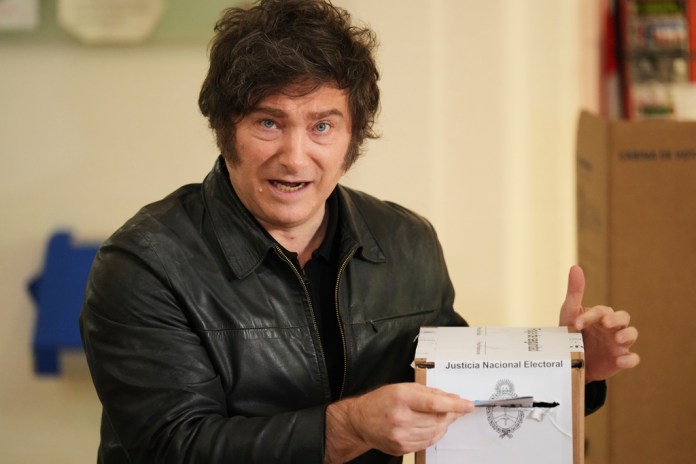
Read full story at Washington Examiner →The political upheaval sweeping Latin America isn't following the old script of left versus right—it's a wholesale rejection of whoever holds power. Argentina's Javier Milei won last year on a platform of dollarizing the economy and eliminating the central bank, defeating both the Peronist left and the establishment right. In El Salvador, Nayib Bukele consolidated near-total executive power while his approval ratings stayed above 90 percent, despite running outside traditional party structures. Guatemala elected anti-corruption firebrand Armelín Ramírez after her predecessor was jailed. Uruguay, Chile's Gabriel Boric, Mexico's Claudia Sheinbaum—each represents a different part of the political spectrum, yet each rode a wave of fury at incumbents. The constant isn't ideology. It's impatience.
What's actually happening is a shift from voting based on what a candidate promises to build toward voting based on willingness to demolish existing institutions. Voters across the region have watched inflation devour savings, watch gangs operate with impunity in neighborhoods where police don't venture, and watched established politicians from both traditional parties recycle the same faces and broken commitments. The left-right framework collapse matters because it means the normal checks and balances that come from alternating power between coherent ideological blocs no longer apply. When Bukele jails opposition figures and dismantle judicial independence while maintaining popular support, or when Milei can propose eliminating Congress and still govern with latitude, it signals that institutional constraints have weakened before new ones have been built.
The closest historical parallel is the 1990s rise of outsiders like Alberto Fujimori in Peru and Hugo Chávez in Venezuela, both of whom won by running against "corrupt elites" and then used that mandate to reshape executive power. But there's a crucial difference: those movements still claimed an ideological anchor. Chávez was revolutionary socialism. Fujimori positioned himself as a technocrat. Today's wave offers no such framing—it's purely punitive. Voters are essentially saying: we don't care what you believe, we care that you can act without obstruction from a compromised system.
From the right's perspective, this is vindication wrapped in a warning. The establishment parties of both left and right spent decades making promises while enriching themselves, allowing state capacity to collapse to the point where gangs run territories and inflation erodes the middle class in real time. Voters finally got tired of waiting for incremental reform and demanded leaders willing to use executive power decisively—to cut spending, reduce bureaucracy, suppress organized crime through force if necessary. Milei's ability to survive initial economic contraction without losing support, or Bukele's near-elimination of gang violence through mass incarceration, proves voters will accept harsh medicine if it works. The risk isn't that leaders have too much power; it's that institutions were already too weak to function, and voters correctly identified that half-measures fail.
The immediate test comes in Argentina's congressional elections in October 2025, where Milei's coalition will either consolidate control or fracture, signaling whether voters are willing to sustain support for an outsider president operating outside party machinery. In El Salvador, the 2024 legislative elections already shifted power further to Bukele's New Ideas party. Guatemala's anti-corruption push will hit its actual constraint when prosecutions reach powerful business figures, not just politicians. Watch whether those governments maintain legitimacy when they start making decisions that hurt their own bases—when austerity actually bites, or when anti-gang operations sweep up innocent people at scale.
What matters for U.S. policymakers and markets is that Latin America is moving toward concentrated executive power without ideological ballast, which means neither the traditional Cold War alliances nor the post-Cold War left-right alignments predict behavior anymore. A leader might be fiscally orthodox one moment and nationalist-protectionist the next. They might crack down on crime with methods that horrify human rights advocates while maintaining democratic elections. The region isn't becoming more stable—it's becoming less predictable, which is worse for everyone except whoever can capitalize on chaos.