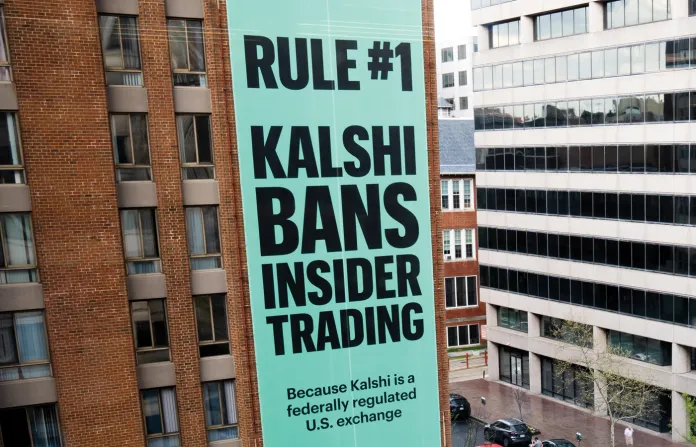
Kalshi and prediction markets experience explosive growth, but also new legal challenges
Read full story at Washington Examiner →Kalshi has transformed from a regulatory curiosity into a genuine financial force in less than a year. The platform, which lets users bet on everything from sports outcomes to political elections to weather patterns, hit $37 billion in monthly trading volume in July alone—a figure that would rank it among the top derivatives exchanges if sustained. The startup's valuation ballooned from roughly $10 billion in November 2023 to $40 billion today, making it worth more than the CME Group's market cap at multiple points this year. This isn't venture capital hype disconnected from actual usage; these are real dollars flowing through contracts written on real events with real financial consequences.
The legal architecture that enabled this growth is surprisingly recent and fragile. For decades, prediction markets operated in a gray zone—technically illegal under the Commodities Exchange Act for most events, but tolerated on offshore platforms and in small academic settings. The turning point came in 2023 when the Commodity Futures Trading Commission quietly allowed Kalshi to launch event contracts on narrow, binary outcomes like "will the Fed raise rates" or "will unemployment exceed 4%." The CFTC carved out an exemption for "political events of historical significance" just before the 2024 election, explicitly permitting contracts on presidential outcomes. Without that regulatory green light, Kalshi wouldn't exist in its current form.
Now the company faces a coordinated pushback from multiple directions. Members of Congress from both parties view prediction markets as either gambling platforms that should be restricted or threats to election integrity if they influence voter behavior. The CFTC itself remains divided—some staff view Kalshi's rapid expansion as creeping beyond the careful boundaries of those original exemptions, particularly as the company adds more speculative contracts. Sports betting interests and state gambling regulators worry about cannibalization of their markets. Kalshi's valuation assumes sustained growth and regulatory tolerance, but $40 billion in market value evaporates quickly if the CFTC reverses course or Congress moves to restrict event contracts the way it restricted online poker after 2006.
The conservative case against Kalshi is straightforward: this is gambling, rebranded and financialized. The argument isn't that prediction markets are worthless—they can genuinely aggregate information—but that Kalshi has built a $40 billion company by making gambling frictionless and infinitely available to millions of Americans who can now place bets on political outcomes while sitting at their desk. The fact that contracts are "binary" and "transparent" doesn't change the underlying mechanics: retail users are placing speculative wagers at 50-50 odds on uncertain events, and Kalshi extracts fees every time they do. The company explicitly targets engagement through marketing and interface design, the same way DraftKings does. Regulatory exemptions carved out for narrow purposes—election transparency, economic indicators—have predictably expanded into a general-purpose betting platform.
The immediate test comes in regulatory actions already underway. The CFTC has scheduled a review of Kalshi's sports betting contracts, which launched in 2024 and have become a major revenue driver. If the agency rescinds those exemptions or imposes tighter capital requirements and position limits, Kalshi's growth trajectory breaks. The company's own SEC filing for its capital raise already warns that "regulatory changes may restrict our ability to offer certain contracts." Congress has also signaled interest—Senator Mitt Romney and Representative Raja Krishnamoorthi have both introduced bills that would explicitly prohibit prediction markets on political events. Neither has momentum right now, but a single major incident—a scandal involving market manipulation, a viral story about someone betting their rent on election outcomes—could trigger legislative action similar to what happened with online poker.
What separates Kalshi from previous fintech disruptions is the speed of regulatory attention combined with genuine uncertainty about the company's legal foundation. Unlike Robinhood or Stripe, Kalshi didn't operate under established regulatory frameworks that scaled with its growth. Every new contract category—from sports to weather to congressional votes—requires a judgment call from an agency that has already shown internal disagreement. A $40 billion valuation is a bet that those judgment calls go