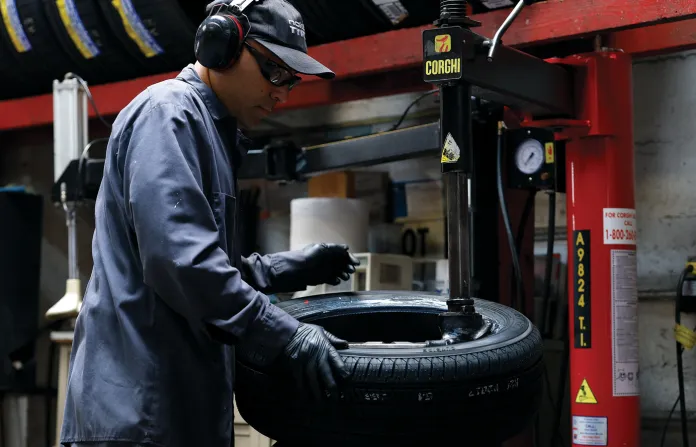
California bans (most) tires
Read full story at Washington Examiner →# Why This Matters
California's Energy Commission didn't just recommend tire efficiency standards—they voted unanimously on September 27 to mandate that all passenger vehicle tires sold in the state meet rolling resistance targets that will eliminate roughly 30% of current tire models from the market by 2030. The regulation requires tires to reduce energy loss during road contact by specific increments, starting at 3% improvement in 2026, ramping to 6.5% by 2030. No manufacturer has explicitly said they'll pull California entirely, but the compliance cost is real: engineers will need to reformulate compounds, retool production lines, and conduct new safety testing. At least three major tire lines currently sold widely in California—including some truck and performance variants—fall below the threshold and have no announced successor models.
The Energy Commission framed this as a carbon play: rolling resistance accounts for roughly 5-8% of a vehicle's fuel consumption, so tighter tires theoretically mean fewer gallons burned, fewer emissions, and lower gas bills for drivers. The math works on paper. A typical California driver might save $50-150 annually on fuel. But that assumes the tire exists, is available, and doesn't cost more. Durability data on the first generation of ultra-low-rolling-resistance tires showed mixed results; some compounds wore faster, which means more frequent replacement and potentially higher total cost of ownership. The commission's own economic impact statement acknowledged prices would rise but offered only vague assurances that "market competition" would stabilize costs. They provided no enforcement mechanism if it doesn't.
What's actually at stake is the precedent. California has already banned gas-powered car sales by 2035 and is now three-quarters of the way through forcing new vehicle emissions standards that exceed federal regs. Tire efficiency is the logical next frontier because it touches existing vehicles—it's not about what you buy next, it's about what you're forced to buy for the car you already own. A conservative read here is straightforward: California is using regulatory authority over the terms of product sales to manage consumer behavior across domains where voters never asked for intervention. Tires aren't a safety issue flagged by the NHTSA. They're not a market failure—tire companies already compete on efficiency because fuel economy matters to consumers. This is California stating that its estimate of the optimal tire spec overrides both manufacturer engineering and individual choice. The state already sets vehicle-purchase terms. Now it's setting tire-purchase terms. The governing logic is "we know better what efficiency level you need," and there's no built-in brake on where that stops.
The federal government could theoretically preempt this under the National Traffic and Motor Vehicle Safety Act, which gives the Commerce Department veto power over state standards that conflict with federal regs. No such conflict currently exists—federal law doesn't set tire rolling resistance targets. But the Biden EPA and NHTSA have deferred to California on emissions for years, treating it as a policy lab rather than an outlier. If Trump's administration takes a different view, it could challenge California's authority on the grounds that tire specifications impact interstate commerce and vehicle safety in ways that demand uniform national standards, not a patchwork. That fight would take years in federal court.
Watch for two immediate reactions: manufacturers will petition the commission before the final rule is published (expected early 2026) to request longer phase-in timelines or grandfathering of existing inventory. More importantly, watch whether other states adopt the same standard. Massachusetts and Vermont have already signaled interest. If five states align on California's tire regs, a de facto national standard emerges—manufacturers comply nationally rather than maintaining California-specific supply chains. If California stays alone, the cost of that isolation gets visible to consumers through price gaps between California and neighboring states. That's the real test of whether this sticks or becomes the next rolling reversal.