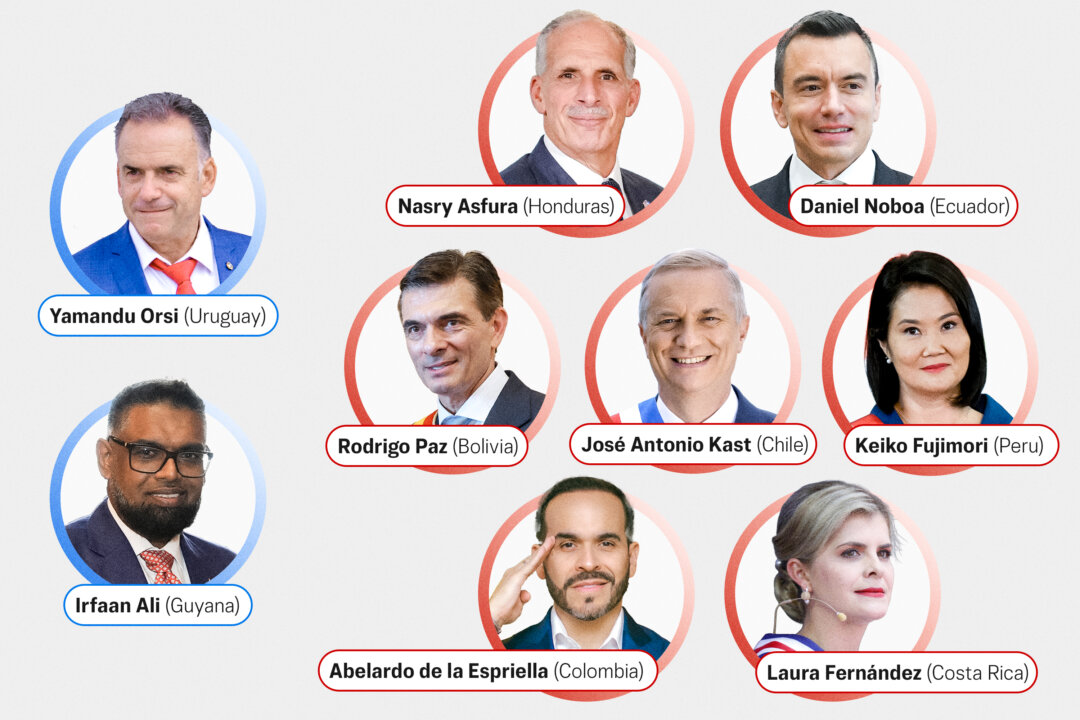
For Decades, the United States Ignored Latin America. All That Changed Under Trump.
Read full story at Epoch Times →# Why This Matters
The Trump administration's approach to Latin America represents a sharp departure from three decades of relative inattention. Since the Cold War ended in 1991, successive U.S. administrations treated the region as a secondary concern—managing drug trafficking and immigration flows while ceding economic and political ground to China and Russia. Trump shifted this calculus fundamentally. His administration imposed tariffs on Mexico specifically tied to migration enforcement, launched maximum pressure campaigns against Venezuela and Nicaragua, renegotiated NAFTA into USMCA with labor and manufacturing provisions designed to reshore production from Asia, and moved the U.S. embassy in Israel to Jerusalem partly to signal alignment with regional allies like Brazil. The specifics matter: Trump increased ICE deportations from the region by 70% in his first term, authorized military assistance to anti-communist partners in Central America, and personally engaged with leaders like Jair Bolsonaro in ways his predecessors had not.
What's at stake is control over the Western Hemisphere's political and economic orientation. For decades, China has deepened its footprint through Belt and Road infrastructure deals, now accounting for roughly 10% of total Latin American trade—up from nearly zero in 2000. Venezuela's collapse has created a migration crisis that directly impacts border states. Drug trafficking organizations operate with near-impunity across weak Central American governments. The Biden administration attempted a "partnership" approach emphasizing climate and anti-corruption work, but that strategy gained no traction with voters concerned about fentanyl flows and asylum seekers. Trump's return to an explicitly hemispheric-first posture—treating the region as an extension of American national security rather than a development challenge—means direct pressure on migration, targeted sanctions on hostile regimes, and economic coercion to align trade patterns toward U.S. interests.
The historical parallel is Reagan's Central America strategy of the 1980s, though with a different mechanism. Reagan used anti-communist ideology and covert support for proxy forces to contain Soviet influence. Trump uses tariffs, deportation enforcement, and direct diplomacy with right-wing leaders as tools. Where Reagan had to justify intervention ideologically, Trump frames it as transactional: Mexico allows migrants through its territory, so Mexico gets tariffs. The difference reveals how the region's geopolitical meaning has shifted—it's no longer primarily about Cold War domination but about managing migration, drug supply chains, and Chinese economic penetration.
The conservative argument here is straightforward and has genuine force: the Biden administration's open-border rhetoric and asylum expansions invited the largest migration waves in U.S. history, creating both humanitarian chaos and domestic political backlash. Latin American governments responded rationally to these incentives by not enforcing their own borders. Trump's tariff threats on Mexico immediately preceded a sharp reduction in migrant crossings—a concrete outcome that matters more than development grants or climate pledges. From this view, the previous three decades of "engagement" with Latin America produced nothing but Chinese economic domination of the region, narco-state consolidation, and waves of migrants. Actual leverage—the threat of tariffs, the prospect of asylum denial, support for anti-communist governments—produces results that don't require explaining to struggling border communities.
Watch for the Trump administration's handling of the CBP One app and asylum processing at the southern border in the coming weeks. Trump has indicated he'll drastically restrict asylum claims, potentially through executive order. That decision will determine whether his tariff threats on Mexico translate into genuine cooperation or escalate into a trade war. Simultaneously, watch for sanctions escalation against Venezuela—the administration has signaled intent to increase pressure on the Maduro regime and its Cuban supporters. These are not symbolic moves. A functional Maduro collapse or genuine asylum reduction would represent the most dramatic shift in U.S. Latin American policy since the Reagan era.