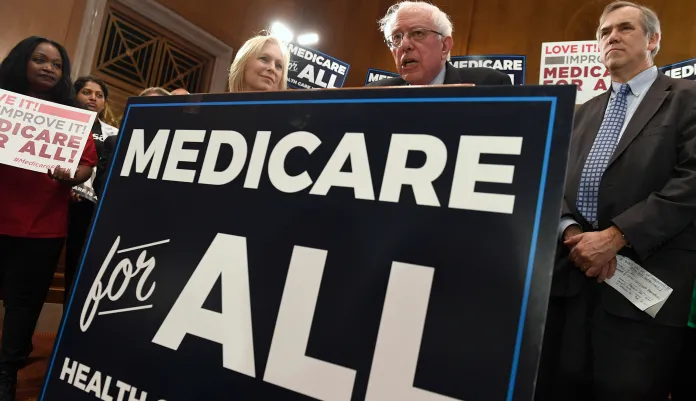
Medicare for All is back on the ballot
Read full story at Washington Examiner →# Medicare for All is back on the ballot
Medicare for All never actually left Democratic primary politics—it just went quiet during the 2024 general election sprint. What's changed is that the silence is breaking. Over the past two weeks, multiple Democratic primary winners have either explicitly endorsed full-scale healthcare nationalization or run on it as their central platform plank. This matters because it signals the party's grassroots is drifting left again after two years of strategic retreat, and it puts moderates like Jeffries in the awkward position of managing a caucus whose primary voters want something their leadership won't say out loud.
The mechanics here are worth understanding. Medicare for All, as currently proposed in the House bill sponsored by Rep. Pramila Jayapal (D-WA), would eliminate private health insurance entirely and consolidate all Americans into a single government program. The bill has roughly 120 House cosponsors—enough for a bloc but nowhere near a majority. When Jeffries dodged the question about bringing it to a vote last month, he was making a calculation: the Biden administration opposed it, Senate Democrats had killed it twice before (2017 and 2021), and voting on something with no chance of passage becomes a symbolic act that just handed Republicans attack ads. Now that primary voters are explicitly choosing candidates who own this position—not hedging, not saying "healthcare is a human right" in abstractions—Jeffries faces a credibility problem with his own base.
The numbers tell the deeper story. A Medicare for All transition would cost roughly $28-34 trillion over a decade according to various analyses, though proponents argue it saves money long-term by cutting administrative overhead and drug costs. It would eliminate roughly 600,000 insurance industry jobs. Premiums would be replaced by a payroll tax around 4% on workers, plus a 7.5% employer tax, with no out-of-pocket costs at point of service. For context: the total U.S. healthcare spending is currently around $4.5 trillion annually. You're talking about a fundamental restructuring of an economy-sized sector, not a policy tweak.
The conservative position on this is straightforward: Democrats are endorsing nationalizing one-sixth of the American economy, and they're doing it in primaries where voters skew younger and further left than the general electorate. The left hasn't won the argument on this—polling shows Americans support "Medicare for All" in theory but oppose it when told it means eliminating private insurance—but they're winning the Democratic Party's internal argument. That's how you end up with a situation where primary winners have to walk back positions when facing general election voters. This is the blueprint for every 2026 House race: tie the Democrat to their own primary promise, make them explain to moderates why they suddenly don't believe what their voters chose them for.
What happens next matters tactically. If Jeffries actually brings Medicare for All to a vote in the House, it forces every Democrat to go on record—good for Republicans running in swing districts, nightmare for Democrats trying to hold suburban seats. If he kills it quietly, he's managing the bloc but breaking the trust of primary voters who just elected pro-M4A candidates. The real deadline is 2025 committee assignments and the first budget resolution, where you'll see whether this freshman class gets real power or gets sidelined. Watch whether any of these new primary winners end up on the Ways and Means Committee—healthcare's ground zero in the House.
The historical parallel isn't perfect but it's worth noting: this is similar to what happened with the Tea Party and Republicans in 2010-2012. Primary voters pushed the party toward a position (defunding Obamacare) that leadership didn't want to own, candidates won by running on it, then the general election dynamics became about managing a caucus you can't actually control. Republicans eventually had to govern with the Tea Party as fact, not theory. Democrats are now in that position with the left wing on healthcare. The difference is healthcare affects more Americans' daily lives than the debt ceiling does—this one actually has to resolve into policy or broken promises.