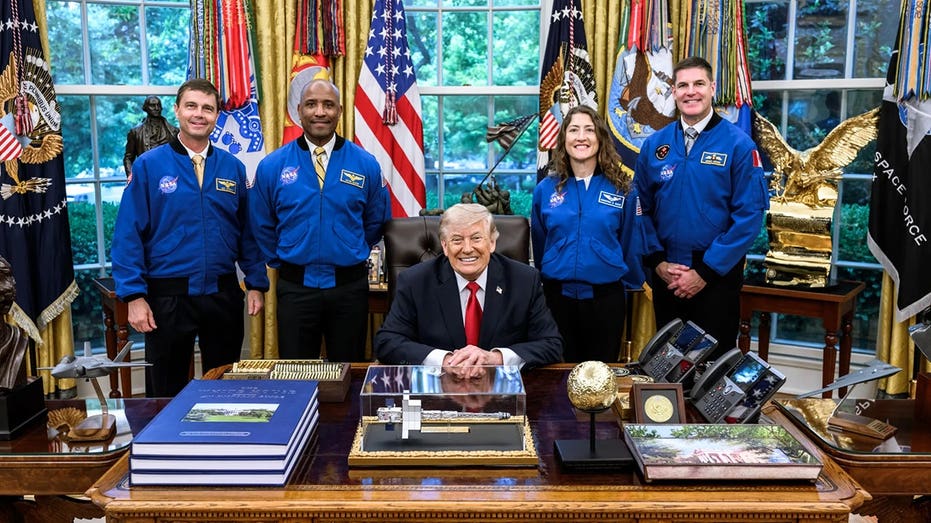
Trump to honor Artemis II astronauts who traveled farther from Earth than any humans in history
Read full story at Fox News →The Artemis II mission launched in November 2022 and flew four astronauts—Reid Wiseman, Victor Glover, Christina Koch, and Jeremy Hansen—on a 10-day lunar flyby that took them 268,563 miles from Earth. That distance exceeds the Apollo 13 record of 248,655 miles, set in 1970. The crew orbited the moon without landing, testing the Space Launch System rocket and Orion spacecraft that will eventually carry humans back to the lunar surface. Trump's August 28 ceremony at Johnson Space Center represents the first official recognition of this achievement since the mission's safe return in May 2024.
The Congressional Space Medal of Honor is the highest civilian space achievement award, typically given for extraordinary accomplishments that advance human spaceflight. The last recipients were the astronauts from the final Space Shuttle mission in 2011. What's significant here is the political messaging: Trump's space rhetoric centers on American dominance and rapid technological progress, and honoring crew members who literally traveled farther than any humans in recorded history aligns that message with measurable fact. For the astronauts themselves, the medal validates a mission many dismissed as merely a test flight rather than the landmark it actually was.
The conservative argument here is straightforward—American space exploration under previous administrations stalled into caution. The Artemis program was announced in 2019, but completion timelines slipped repeatedly under Biden. Trump's early signals about accelerating lunar return missions and prioritizing speed over bureaucratic delay resonate with the fact that no American has set foot on the moon in 52 years. The medal ceremony frames the current administration as honoring actual achievement and pushing toward the next phase, not just incrementally funding a program designed by predecessors.
The relevant precedent is JFK's handling of space exploration as American identity. Kennedy positioned the moon race as civilizational competition and personal accomplishment simultaneously, celebrating Alan Shepard and John Glenn while using their flights to project national competence. The Artemis II ceremony follows that playbook: public ceremony, specific heroic accomplishment, connection to larger mission goals. Where it differs is that Artemis II wasn't a race against an adversary—no other nation was conducting similar missions—so the achievement is purely technological and exploratory rather than Cold War-inflected.
The immediate watch point is whether NASA confirms the Artemis III landing mission timeline. Trump has promised lunar landings before 2026; the agency's current schedule shows late 2026 at the earliest. The Artemis II astronauts have not been assigned to Artemis III, so Koch, Wiseman, Glover, and Hansen won't be the ones stepping on the moon. If the ceremony becomes an opportunity to announce Artemis III crew assignments or revised timelines, that's where the politics and space policy actually intersect. Otherwise, it's ceremonial recognition of something that already happened.