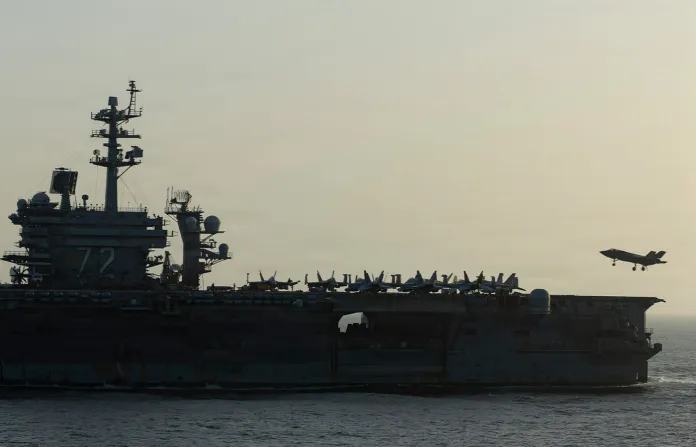
America’s commitments have outrun its fleet
Read full story at Washington Examiner →# Why This Matters
The U.S. Navy is stretched across a global commitment structure built for a force that no longer exists. With only 11 active aircraft carrier strike groups and over 5,000 miles of ocean to cover simultaneously—the Indo-Pacific alone, the Middle East, the Atlantic, and the Mediterranean—the service is operating with what strategists call a structural mismatch. The USS Abraham Lincoln's extended deployment cycle, extended again, isn't a scheduling quirk; it's a symptom of the Navy trying to maintain a forward presence in regions where peer competitors like China are actively testing American resolve. The arithmetic is brutal: maintaining continuous presence in two major theaters requires roughly 2.5 to 3 carrier groups per region when accounting for maintenance cycles and crew rotation. The Navy doesn't have that.
What's actually at stake is whether the U.S. can enforce its stated security commitments without breaking the people enforcing them. Sailors on extended deployments face burnout, divorce, and mental health crises at rates that spike during consecutive extended tours. That feeds retention problems—the Navy missed its recruitment target by 15,000 sailors in 2022, and even as it recovered, attrition among experienced personnel remains elevated. When carriers stay deployed longer, their crews get home less, training suffers, and maintenance gets deferred. The Lincoln's issues weren't invented in a vacuum; they're what happens when a ship and its crew operate beyond intended parameters. Functionally, the Navy is cannibalizing readiness in some areas to maintain presence in others.
The strategic problem maps onto a hard geopolitical fact: the Chinese Navy now has more total ships than the U.S. Navy, and it's building three times faster. The Pentagon's stated requirement is 355 ships; the Navy currently operates roughly 290. Beijing has over 330 vessels, most of them built in the last decade. This gap existed in abstract policy debates for years before it became concrete—before carrier strike groups had to skip maintenance, before sailors' second deployments turned into third ones. The comparison to Cold War Naval competition is inexact because that was a decades-long arms race with time built in. This is competition in compressed timeframe against an opponent who's already in the water.
The conservative position on this is straightforward: stop treating global naval presence as a default entitlement. The U.S. Navy's job is defending America and its core allies, not maintaining a show of force in every theater simultaneously. If commitments exceed capacity, either build more ships or commit to fewer forward positions—but don't shred the readiness of the force you have by pretending you can do both. Congress has been appropriating money for shipbuilding, but the manufacturing pipeline takes years to produce hulls; meanwhile, the Navy is using the ships it has as substitutes for strategic clarity. That's not a problem with military budgets. It's a problem with political decisions that create infinite commitments backed by finite resources. Either defend the Indo-Pacific properly or stop pretending carrier strike groups can be everywhere.
The concrete next step: the Pentagon's classified threat assessment on China's military capabilities, due to Congress in February, will likely quantify the readiness gap in terms that force congressional hand. Separately, watch the House Armed Services Committee's markup of the defense budget in spring—if there's momentum to increase the shipbuilding budget or reduce forward-deployment commitments, that's where it surfaces. The Navy itself is supposed to release an updated force structure assessment by mid-2024 that will either justify the current commitment level or finally admit it can't sustain all of them.