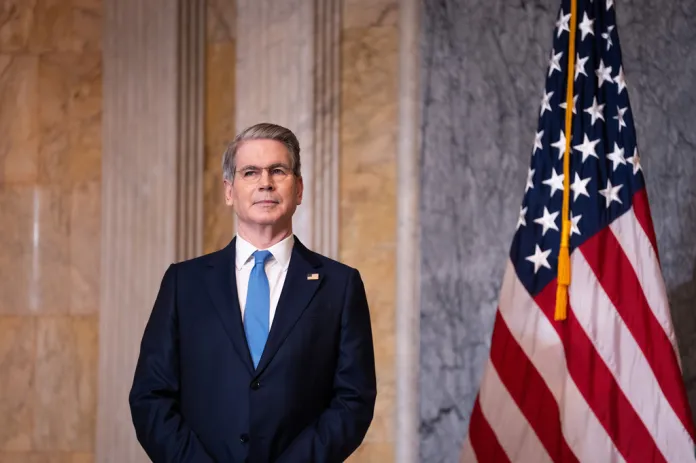
Scott Bessent cannot save the bond market from Congress’s $40 trillion national debt
Read full story at Washington Examiner →Scott Bessent became Treasury Secretary in February promising to restore confidence in U.S. debt markets through fiscal discipline and market-friendly policy. Instead, he's inherited a catastrophe that his appointment was supposed to prevent. The 10-year Treasury yield has held stubbornly above 4.5% for weeks, while the 30-year bond yield crossed 5.3% last week—the highest since 2009—signaling that investors are losing faith in the government's ability to manage its obligations. This matters because when bond yields spike, borrowing costs for mortgages, car loans, and corporate debt rise across the entire economy. The federal government itself will face $659 billion in interest payments this year alone, a figure that has roughly tripled since 2020 and now consumes more of the budget than Medicare or defense spending.
The bond market's skepticism isn't theoretical worry—it's a direct response to arithmetic. The national debt sits at $40 trillion, and Congress has shown no appetite for the spending cuts or tax increases needed to stabilize it. The Congressional Budget Office projects deficits will average $2.5 trillion annually over the next decade under current policy. Treasury auctions have required higher yields just to attract buyers, and foreign central banks—particularly Japan and China—have been net sellers of U.S. debt for months. Bessent's stated plan to cap the deficit ratio and push for a "strong dollar" can't move markets if Congress keeps spending $2+ trillion more than it collects in taxes each year. He's steering a ship whose passengers have voted to flood the hull.
The parallel here is Britain in the 1970s, when governments spent beyond their means while inflation spiraled, confidence in gilts collapsed, and the pound crashed. The Bank of England eventually had to raise rates aggressively and accept a severe contraction to restore credibility. The key difference is that America's reserve currency status has given it vastly more borrowing room—and far more time to ignore the problem. That cushion is eroding.
From the conservative angle: This is what happens when a Treasury Secretary becomes a public relations officer for an unsustainable system. Bessent can talk about "restoring fiscal sanity" and make nice with Wall Street, but he serves at the pleasure of a Congress spending money it doesn't have. Republicans control the House and Senate—they have the power to cut spending tomorrow and have chosen not to. The bond market is correctly pricing in the reality that neither party will make the hard choices before a genuine crisis forces them. Bessent's job is to manage the decline, not fix it. Expecting him to restore confidence is like expecting a brand manager to fix a product that's fundamentally broken.
The next critical test comes when Congress reaches its debt ceiling—likely around April 2025—and must vote to raise the borrowing limit again. If yields spike further before that vote, the political pressure could force a showdown. Separately, watch for the Fed's next moves: if inflation re-accelerates while Treasury yields are already high, the Fed may face pressure to hike rates again, which would crater bond prices and push yields even higher. Bessent will need to navigate both crises simultaneously. Any sign that foreign central banks are accelerating sales of U.S. debt would signal that confidence is shifting structurally, not just cyclically—a moment when no Treasury Secretary's rhetoric survives contact with market reality.