Ceuta in chaos as traffickers move migrants to Spain and Madrid accepts 500 at-risk girls
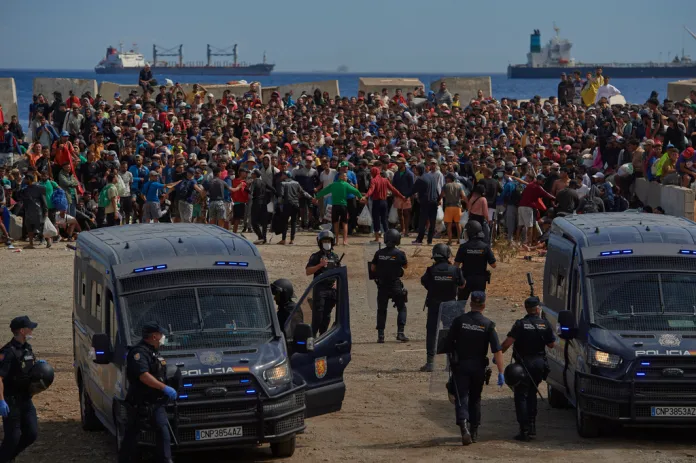
Read full story at Washington Examiner →Spain's autonomous city of Ceuta—a Spanish enclave on Morocco's northern coast with a population of just 18,500—has become a pressure valve for North African migration networks, and Madrid's latest move suggests the valve is jammed wide open. In recent weeks, thousands of migrants have landed on Ceuta's beaches after paying traffickers, overwhelming local authorities who lack the infrastructure to process or deport them. The Spanish government, facing political heat from Ceuta's residents and regional politicians, initially promised to prevent transfers to mainland Spain. That promise lasted weeks. Madrid has now agreed to accept 500 unaccompanied minors—specifically girls deemed at-risk—setting a precedent that virtually guarantees escalation.
The mechanics of what's happening are straightforward: smugglers charge migrants (primarily from sub-Saharan Africa and West Africa) anywhere from $200 to $800 for a boat crossing to Ceuta, betting correctly that overcrowding will force Spanish authorities to choose between indefinite detention in a territory that can't absorb them or grudging transfers to mainland processing centers. Once a few hundred migrants successfully make the transfer, the incentive structure shifts for everyone waiting on Moroccan beaches. Word spreads. More boats arrive. Ceuta's beaches become staging grounds. This isn't incidental chaos—it's the predictable outcome of a policy that signals: arrive here, create enough administrative pressure, and you'll be processed into Europe.
The broader context reveals why this matters now. The EU's asylum system has fractured repeatedly over the past eight years, with countries like Hungary and Poland flatly refusing mandatory migrant quotas while countries like Spain and Germany absorb disproportionate shares. Italy's government under Giorgia Meloni has explicitly hardlined on migration, leaving Spain as the political weak link in Europe's southern tier. Ceuta, geographically isolated and politically subordinate to Madrid, became a testing ground. Traffickers and migrants recognized this faster than Madrid's politicians did. The result: a localized crisis that exposes the EU's inability to enforce uniform border policy when individual member states face domestic pressure.
The conservative argument here doesn't require exaggeration: Madrid promised containment and delivered capitulation. Accepting 500 vulnerable minors on humanitarian grounds sounds defensible until you recognize what it actually signals—that sufficient numbers, sufficient desperation, and sufficient media attention override stated policy. The traffickers already know this. The message isn't subtle: get to Ceuta, wait, and the Spanish state will eventually absorb you. If Madrid wanted to stop this, it would need to do what it explicitly said it wouldn't: keep migrants in Ceuta, process them there, and deport them faster than new arrivals land. Instead, it's doing the opposite, which means expect Ceuta's beaches to resemble refugee camps before summer.
Watch for two mechanisms in the coming weeks. First, pressure on Madrid to accept additional transfers beyond the initial 500 girls—the Ceuta regional government will demand it publicly, and humanitarian organizations will litigate it quietly through Spanish courts. Second, watch Italy's response. Meloni's government has spent two years boasting about its hardline stance. If Spain's capitulation doesn't result in consequences (EU sanctions, burden-sharing reversals, political isolation), Italy will face internal pressure to soften its own stance, which destabilizes the only remaining European government treating migration as a sovereignty issue rather than an administrative challenge. The EU's next binding moment will be whether Madrid's move becomes precedent or aberration—and that determination happens in rooms in Brussels, not on Ceuta's beaches.