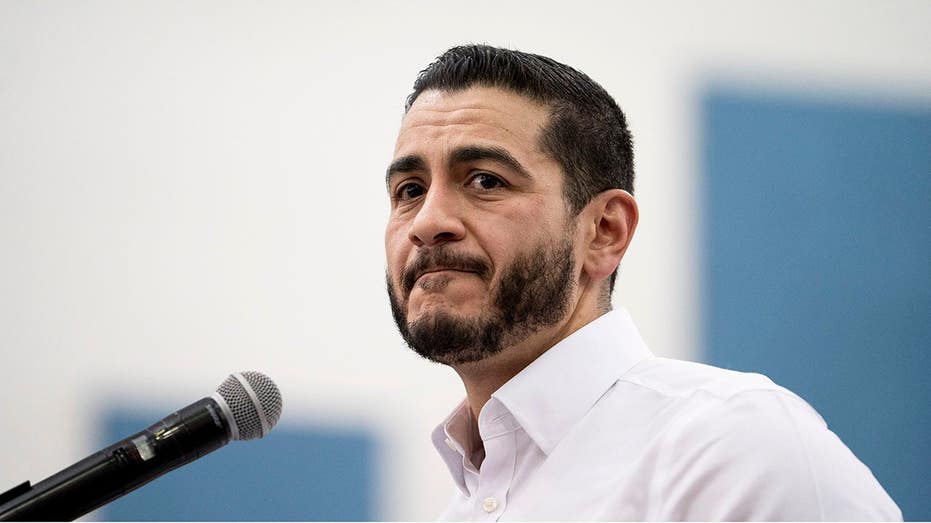
El-Sayed argued against the Second Amendment in unearthed social media videos
Read full story at Fox News →Abdul El-Sayed, a 42-year-old progressive activist and former Michigan health director, archived approximately 100 YouTube videos in 2023 before announcing his Senate run against Republican incumbent Peter Meijer. The videos, posted between 2015 and 2022 under his "America's Doctor" channel, included commentary on gun control, healthcare policy, and other progressive causes. El-Sayed's campaign has not disputed the existence or content of these videos—only that they were made private rather than deleted, a standard practice for candidates scrubbing past media before launches. The disclosure matters because Michigan is a swing state where gun rights carry enormous political weight, and El-Sayed is competing in a Democratic primary that could determine who faces Meijer in a general election that will likely decide Senate control.
The specific content El-Sayed advocated for in these videos was a constitutional amendment to modify Second Amendment protections—not a ban on firearms, but a structural rewrite of the amendment itself. This is materially different from typical gun-control advocacy. Constitutional amendments require 67 Senate votes and ratification by 38 states, making this a maximalist position on gun policy that goes well beyond background checks or assault weapon restrictions. In clips El-Sayed has acknowledged making, he argued that the Second Amendment's language about a "well-regulated militia" was outdated and that modern gun regulations were constitutionally permissible. For a candidate in Michigan—where hunting culture is embedded in the state's identity and gun ownership crosses partisan lines—this represents significant political liability in both the primary and general election.
This echoes Howard Dean's 2004 presidential campaign, where a single passionate moment at a rally ("BYAAAH!") became his defining image and essentially ended his candidacy despite strong early momentum. The parallel isn't perfect—Dean's was one moment, El-Sayed's is 100 archived videos—but both cases show how digital records can become liability for candidates once the primary accelerates and opposition research activates. The difference is that El-Sayed's content was deliberately hidden, which raises questions about judgment and transparency that the Dean moment didn't.
The conservative case against El-Sayed is straightforward: he believes the Constitution should be rewritten to weaken gun rights, hid evidence of that belief before running for office, and is now hoping Michigan voters won't notice. This isn't a difference of opinion on regulation—it's a position that the fundamental law should be altered to curtail a constitutional right. Peter Meijer's campaign will argue that El-Sayed spent years building an intellectual case for constitutional revision, then attempted to scrub the internet clean of evidence before facing voters. In a state where the Second Amendment remains a defining political issue, this creates a structural problem for El-Sayed that no amount of spin about "archiving" versus "deleting" can fully resolve.
The immediate test is the Michigan Democratic primary, where union voters and rural Democrats could prove decisive. If El-Sayed advances to the general, expect the full archive to become opposition ad material. The next concrete moment is whether other Democratic primary candidates use this footage in advertising or debates—that will determine whether this story stays contained within political circles or breaks into mainstream coverage. Watch also for whether Meijer's campaign immediately launches digital ads using El-Sayed's own words, which is the fastest way to make archived videos matter to persuadable voters who won't see Fox News reporting.